
Rynek i regulacje
Przydomowe Magazyny Energii 2.0: EMS Requirements and Equipment Selection
Przydomowe Magazyny Energii 2.0: up to 16,000 PLN for storage and conditionally up to 19,000 PLN in total per one PPE. The call for proposals started on October 20, 2026. Check the EMS requirements, storage capacity, backup, and documentation of the FoxESS set.
Have you already received a call from a customer? "I heard they are giving subsidies for energy storage again". They are. But this time, the battery alone is not enough. Below: how much the subsidy is, what the EMS must comply with, where people stumble most often, and how to select a set so as not to correct documents after installation.
What is the Przydomowe Magazyny Energii 2.0 program?
It is a subsidy for prosumers who have a RES micro-installation connected to the grid and want to increase self-consumption. The funding covers:
- electrical energy storage with a capacity of at least 10 kWh,
- heat storage with a capacity of at least 100 dm³ (manufactured in the EU),
- the possibility of additional support for the necessary replacement of an inverter with a hybrid one manufactured in the EU (on the terms described below).
The program's budget is up to 1 billion PLN. Eligible expenses are those incurred from November 1, 2025, and applications are submitted exclusively electronically, through the Generator Wniosków o Dofinansowanie (GWD) of NFOŚiGW.
Subsidy for energy storage in PME 2.0 – how much is it?
| Element | Subsidy |
|---|---|
| Energy storage (net-billing) | up to 30% of costs, max 800 PLN/kWh, max 16,000 PLN |
| Energy storage (net-metering) | up to 30% of costs, max 800 PLN/kWh, max 8,000 PLN |
| Heat storage | up to 30% of costs, max 1,000 PLN |
| Bonus for the necessary replacement with a hybrid inverter manufactured in the EU or storage manufactured in the EU | up to 2,000 PLN; together with the storage subsidy, no more than 50% of the eligible costs of the storage |
| Total per one PPE | max 19,000 PLN |
The subsidy for energy storage depends on the eligible costs, nominal capacity, and the prosumer's billing system. The amount of 19,000 PLN is a total, conditional limit per one PPE, which also includes heat storage and an additional bonus.
Two things are worth keeping in mind when pricing:
- the purchase and installation price of the storage itself (without the inverter and EMS) cannot exceed 3,000 PLN per 1 kWh of nominal capacity,
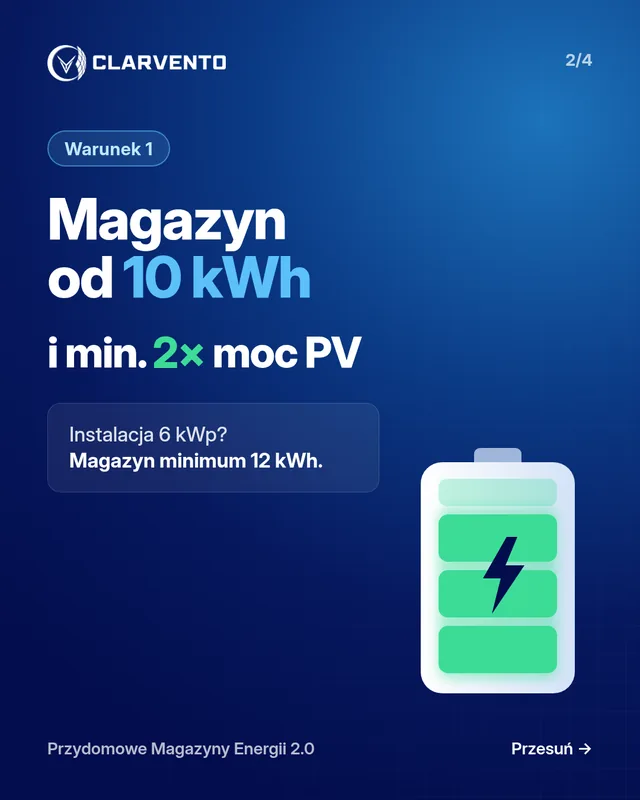
- the storage capacity in Wh must be at least twice the PV power in Wp. A 6 kWp installation? Minimum 12 kWh storage.
What requirements must the EMS meet?
This is where it gets most interesting. The program defines EMS as a system that intelligently controls the energy flow according to priorities: first current consumption, then energy storage, heat storage, and finally sending surpluses to the grid.
The minimum that the EMS must be able to do:
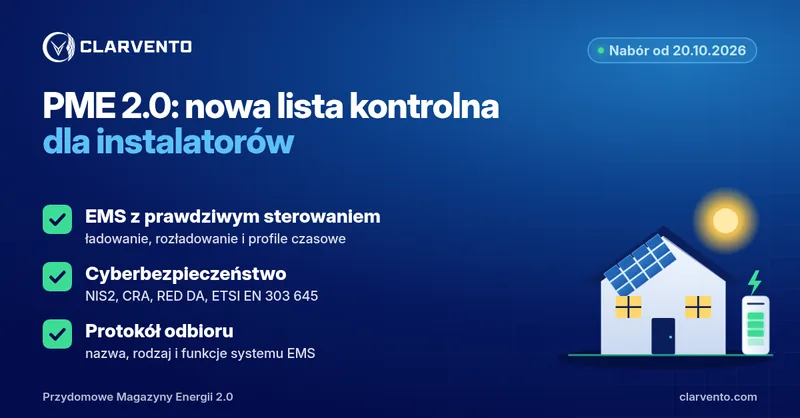
- control storage charging,
- control storage discharging,
- operate based on time profiles.
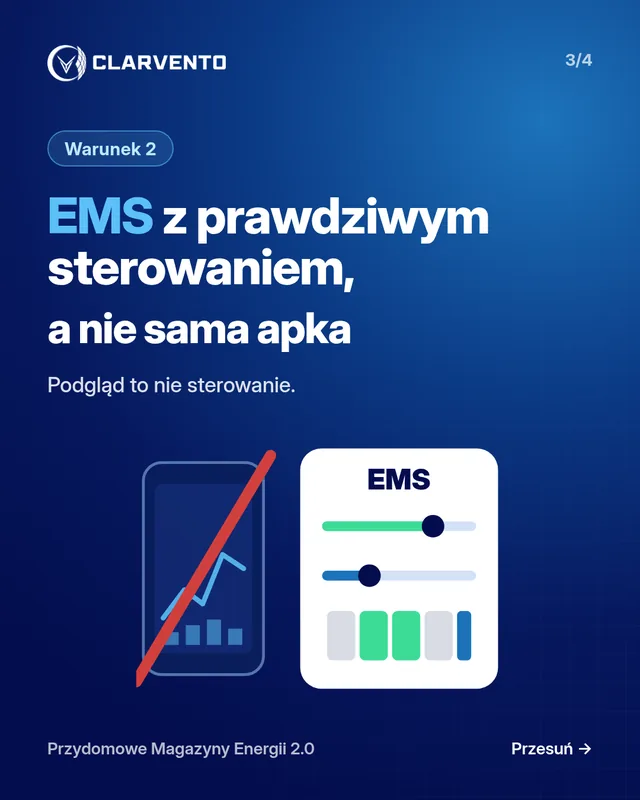
The program explicitly excludes "simple controllers or visualization applications" that do not make decisions and do not analyze weather or economic data. In short: just viewing charts on a phone is not an EMS.
The EMS can be built into the hybrid inverter, act as a storage control module, or as an external system. The name of the EMS system, its type, and functionality must be provided in the application and the acceptance protocol.
What about cybersecurity?
The EMS must meet the requirements resulting from NIS2, CRA, RED DA, and the ETSI EN 303 645 standard (the last two for devices manufactured after the regulations come into force). According to the program's FAQ:
- the requirements apply primarily to the element that serves as the EMS,
- if the inverter is controlled by the EMS via cable, it does not have to meet these requirements itself,
- if the connection is wireless or the inverter is on a Wi-Fi network, both devices must meet them.
Therefore, when selecting, the question "does it have an EMS?" is not enough. A better one is: "can the whole set be defended in the documents?".
FoxESS energy storage and PME 2.0 requirements
FoxESS has published the current declaration of EMS functions for Poland, version 1.0 from October 19, 2026. In it, the manufacturer indicates the H1-G2, H3, P3-Smart, P3-Pro, and PQ3-Plus series. The scope of models and software versions should be checked in the declaration and the current data sheet of the specific device.
According to the declaration, the FoxESS EMS supports:
- charging and discharging control and their power limits,
- time profiles and operating modes in FoxCloud, including self-consumption, peak shaving, and backup,
- analysis of economic data, PV production, and weather forecasts,
- Modbus TCP/RTU and API communication, as well as cooperation with heat storage via SG Ready.
Important when assembling the set: for the H1-G2, H3, P3-Pro, and PQ3-Plus series, the manufacturer indicates the WLan-WW Wi-Fi module as required to meet cybersecurity requirements. It must be installed and shown in the protocol and on the invoice. The declaration also provides the method of EMS identification, e.g., "FOXESS EMS – P3-10.0-SH", and the requirement for a separate EMS item on the invoice.
The document lists DEKRA certificates, including EN 18031-1/2:2024 and ETSI EN 303 645, indicating the scope of models, modules, and software versions. The compliance of one model should not be transferred to all products of the brand.
Check the current FoxESS EMS declaration for PME 2.0. As a FoxESS sub-distributor, we will help you choose a set and provide the manufacturer's documentation for the acceptance protocol. The manufacturer's declaration does not replace the assessment of the complete application by NFOŚiGW.
What are the most common stumbling blocks?
- Storage is too small. The "2 × PV power" rule eliminates many offers even before submitting the application.
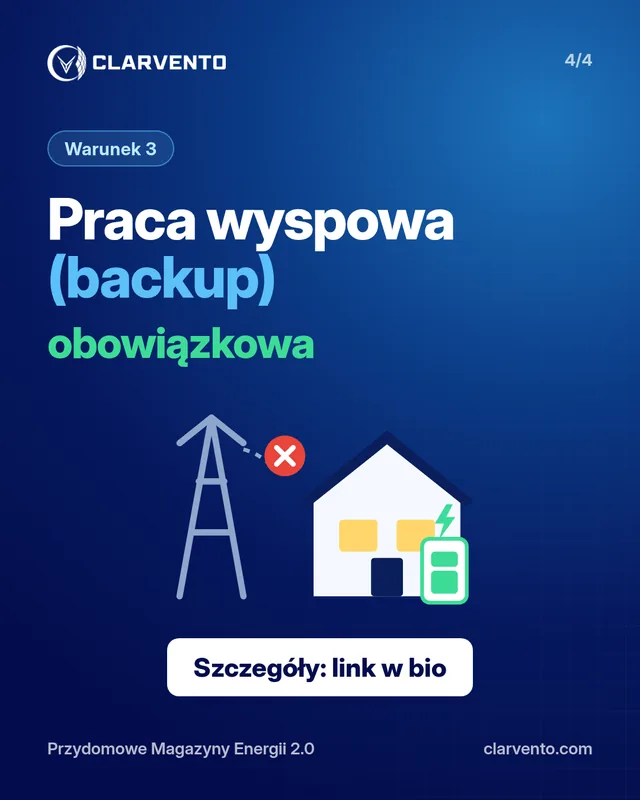
- No island mode. The set must provide backup power in case of a grid failure. Without it, there is no subsidy.
- "EMS" as just an app. Viewing is not controlling.
- Self-assembled batteries. Uncertified storage is excluded.
- Documents. Prepare, among others, invoices, payment confirmations, a current DSO certificate with storage data, product sheets, photos of devices and nameplates, as well as the acceptance protocol and other attachments indicated by NFOŚiGW.
None of this is difficult. The problem only starts when it comes to light after installation.
How to select a set for PME 2.0 in Clarvento?
- Check the PV installation power and calculate the minimum storage capacity (2 × kWp).
- Choose an energy storage and a compatible hybrid inverter with EMS and a backup function.
- If the customer also plans to store heat, choose a buffer tank or a cylinder for a heat pump (only EU production).
- Ask us for the manufacturer's documents: product sheet and EMS statement.
We also write about why it is worth checking the compatibility of components before buying in the guide how to choose a photovoltaic wholesaler and PV supplier. Before the equipment reaches the construction site, we will check if the inverter, battery, and EMS will really get along.
The EMS system is required, but its purchase alone is not an eligible cost. Check the selection of devices, backup configuration, and the set of documents before installation.
FAQ
When did the PME 2.0 call for proposals start?
October 20, 2026, at 9:00 AM. Applications are submitted electronically in the GWD of NFOŚiGW.
Will the inverter also receive funding?
Not directly. However, you can get an additional up to 2,000 PLN if replacing it with a hybrid inverter manufactured in the EU is necessary for the storage to operate, or if the storage itself is manufactured in the EU.
Does the EMS have to be a separate device?
No. It can be built into the hybrid inverter, act as a storage control module, or as an external system.
What is the minimum energy storage in the program?
10 kWh and simultaneously at least twice the power of the PV installation (in Wh relative to Wp).
Do purchases before the call for proposals count?
Yes, if the purchase, installation, and notification to the operator occurred from November 1, 2025.
Let's talk about sets for PME 2.0
Do you have customers asking about the subsidy? You don't have to start with a large order. Send us the installation power, and we will propose a compatible set and send the documentation. Create a B2B account or write to us.
Information based on the PME 2.0 program rules, NFOŚiGW FAQ, and the list of required documents (as of October 21, 2026), as well as FoxESS documentation. Program conditions may change. Before submitting an application, check the current call regulations.
Galeria
Przeczytaj również
Clarvento is the official Hinen distributor in Poland. Orders, quotes, and cooperation
Clarvento is the official Hinen distributor in Poland. For us, it is not just another brand in our offer, but a cooperation that we consistently develop. We already have our first Hinen sub-distributor, we are expanding product availability, and we invite more installers, contracting companies, and trade partners to cooperate.
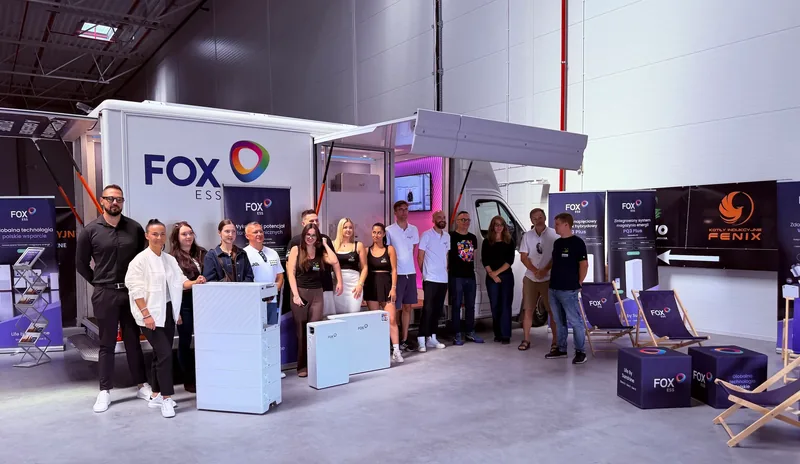
FoxESS Tour 2026 in Wrocław: Practical Knowledge, Meetings and Special Clarvento Offer
The first Wrocław stop of the FoxESS Tour 2026 is already behind us. See what the meeting of installers with experts looked like and ask about Clarvento's special offer for FoxESS solutions.
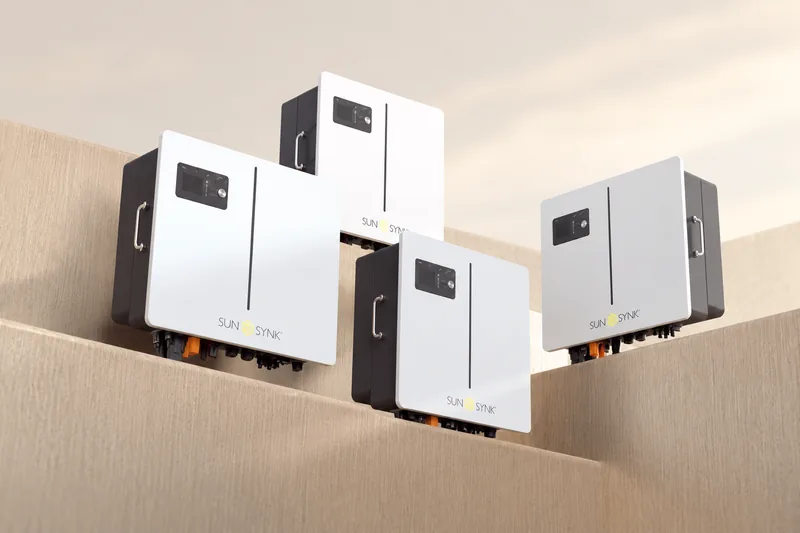
Sunsynk LP hybrid inverter: selection for PV and energy storage
How to combine photovoltaics, energy storage, and backup power? We explain the operation of Sunsynk LP and the parameters an installer should check before selecting a system.